



Applications
Pressure, leak and burst testing with water – mobile or stationary.
Fields of application
KDDPA systems and PTJ / PTM pumps are used wherever compressed air is available and high or very high liquid pressure is required.
Pressure & burst testing
Static pressure and burst testing of hoses, pipes, valves and fittings.
Vessels & hydraulic systems
Pressure testing of vessels, pressure equipment, hydraulic systems and hydrogen installations.
Pressure source
Power source for hydraulic presses, bolt cutters, clamping systems, impregnation and injection systems.
Hazardous areas & outdoor
ATEX pumps and stainless-steel housings – in the test field, on site or outdoors.
How a pressure test works
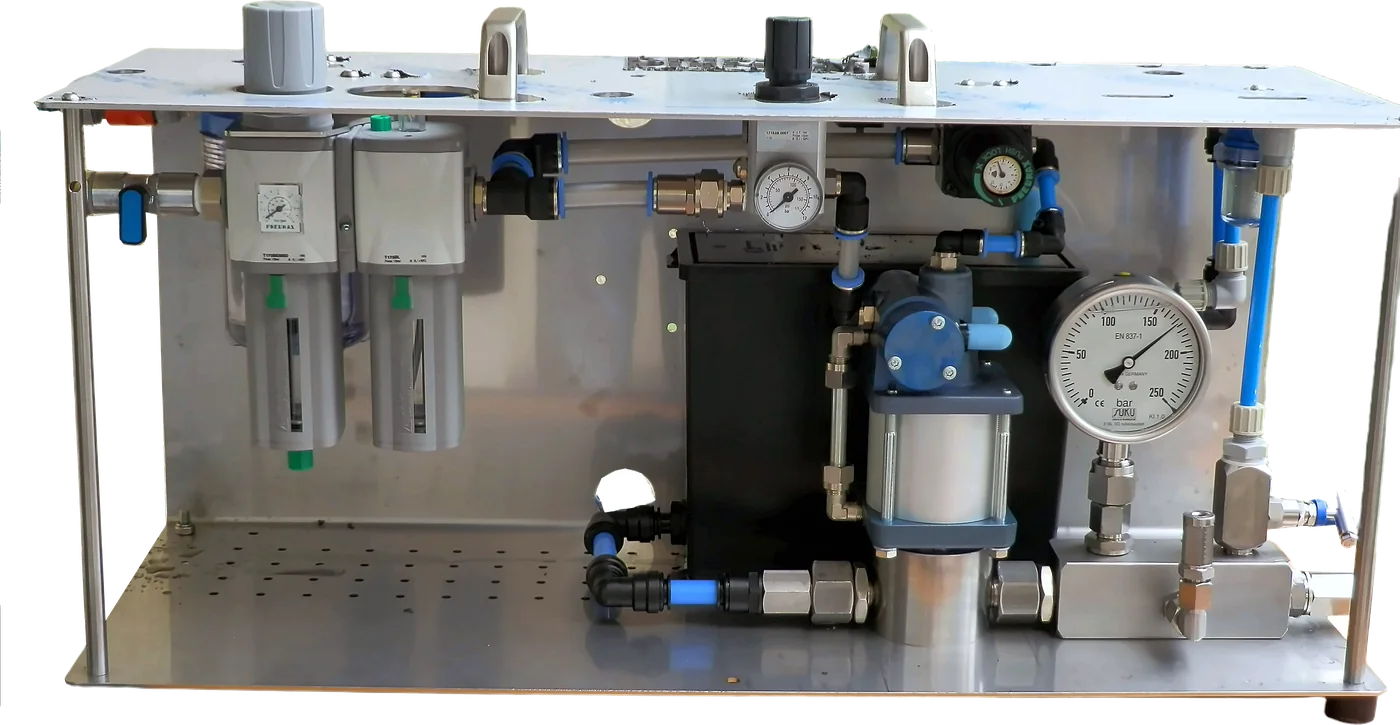
For pressure testing, the systems to be tested are filled with water at low pressure, vented and then brought to the required test or burst pressure by the KDDPA high-pressure system.
Connect
Water (“Gardena”-compatible) and compressed air on the left, test specimen on the right at the high-pressure outlet.
Fill & vent
Fill the test specimen at low pressure and vent it completely – optionally with bypass for fast filling.
Build up pressure
Set the test pressure with the precision pressure regulator – the pump stops automatically when it is reached.
Hold & relieve
Hold and observe the pressure, then relieve it gently via the needle valve.
Accuracy & tightness
Absolute tightness is practically impossible. There is no such thing as an absolutely tight component – so absolute tightness cannot be established by any test method. Particularly with very small test volumes and low pressures, the measured pressure will drop over time: residual air always remains in the test specimen, and in the pump’s check valves the pressure supports the closing force – the lower the pressure, the more easily fluid can diffuse through the seat. A test system must therefore always be matched to the test specimen.
Possible measurement errors
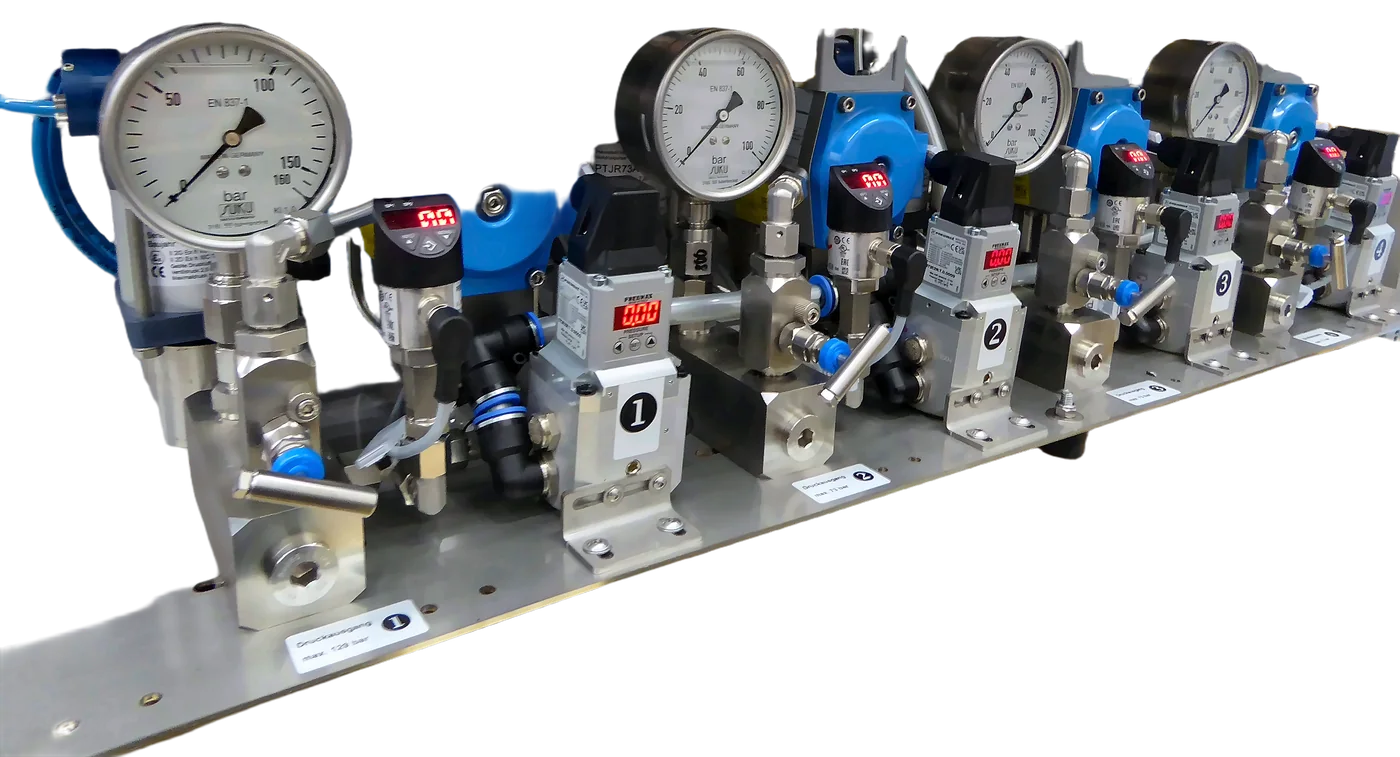
- Sensor / pressure gauge: usually max. ± 0.25 % of the nominal value – i.e. ± 0.25 bar for a 100 bar sensor
- Temperature: if the ambient temperature changes, the measured pressure changes too
- Pneumatic pressure regulator: set-point input via 0–10 V with a hysteresis of ± 0.3 % – approx. 200 to 300 pressure steps; with a PTJR126A this gives steps of approx. 0.5 bar
- Test specimen “settling”: it continues to expand slowly for some time after pressurisation
Experience shows that a system tends to work more accurately with lubricated air – up to 100 bar, accuracies better than 0.2 bar can be achieved in the best case. Calibrated sensors and pressure gauges with 3.1 certificate are available as an option.
Inspections to TRBS 1201 Part 2
The German Technical Rule for Operational Safety TRBS 1201 Part 2 prescribes inspections for hazards from steam and pressure. What this means for KDDPA test systems:
No Pressure Equipment Directive
Our systems themselves are not subject to the Pressure Equipment Directive – the volumes are too small.
No ageing parts
The systems themselves have no pressure-bearing parts that age (hoses etc.).
Water as medium
There are no further regulations for water hydraulics: the medium poses no environmental hazard and is neither toxic nor flammable. Owing to its low compressibility, the stored energy is very low.
Inspect external components
Components outside our system, such as pressure hoses, must however be inspected.
Your pressure test – our test system
Tell us the test pressure, test medium and test specimen – we will configure the right KDDPA system or build your test bench to specification.
Send an enquiry